EXPRESSIVE SPEECH ACTS AS PEDAGOGICAL FEEDBACK: A PRAGMATIC INSIGHT INTO EFL SPEAKING CLASS INTERACTION

 Abstract views: 14
,
Abstract views: 14
,
 PDF downloads: 12
Abstract
This study examines how expressive speech acts function as pedagogical feedback in an English as a Foreign Language (EFL) speaking classroom. Drawing on Searle’s taxonomy of speech acts and a pragmatic discourse-analytic approach, the research identifies the types of expressive speech acts used by the teacher and explains their pragmatic and pedagogical functions. A qualitative descriptive design was employed, utilizing classroom observations, audio recordings, and field notes as the primary data sources. The findings show four types of expressive speech acts: praise, thanking, encouragement, and positive acknowledgment. Praise appeared most frequently and provided immediate reinforcement, supporting student confidence and participation. Encouragement helped reduce anxiety and prepared learners for speaking tasks. Thanking maintained politeness and mutual respect, while positive acknowledgment strengthened motivation and affirmed student progress. The study concludes that expressive speech acts serve both affective and instructional functions, helping to build a supportive classroom atmosphere and promote active engagement in EFL speaking activities. The findings suggest that expressive feedback deserves greater attention as a deliberate pedagogical strategy rather than an incidental feature of teacher talk.
Downloads
References
Al Halim, M. Labib, Salamun, and Omnia Mohamed. “Teachers’ Challenges and Approaches in Enhancing Students’ Speaking Skills within the Merdeka Curriculum in Junior High School.” JALIE: Journal of Applied Linguistics and Islamic Education 9, no. 1 (2025): 171–188. https://doi.org/10.33754/jalie.v9i1.1492.
Al-Subahi, Ali. "Speech Acts in Teacher Feedback: A Pragmatic Analysis of EFL Classrooms." Asian EFL Journal 28, no. 3 (2021): 91–109.
Arjulayana, and Tri Pujiati. “Optimize Communicative Language Teaching (CLT) Approach for Non-English Learners’ Speaking Skill.” JALIE: Journal of Applied Linguistics and Islamic Education 8, no. 2 (2024): 215–238.
Astuti, Wahyu, and Fitri Lestari. "Teachers’ Speech Acts and Their Pragmatic Functions in EFL Classroom Interaction." Indonesian Journal of Applied Linguistics 10, no. 3 (2020): 600–610. https://doi.org/10.17509/ijal.v10i3.24791
Austin, J. L. How to Do Things with Words. Oxford: Oxford University Press, 1962.
Black, Paul, and Dylan Wiliam. “Assessment and Classroom Learning.” Assessment in Education: Principles, Policy & Practice 5, no. 1 (March 1, 1998): 7–74. https://doi.org/10.1080/0969595980050102.
Brookhart, Susan M. How to Give Effective Feedback to Your Students. Ascd, 2017.
Brown, H. Douglas. Teaching by Principles: An Interactive Approach to Language Pedagogy, 3rd ed. White Plains, NY: Pearson, 2007.
Canale, Michael, and Merrill Swain. "Theoretical Bases of Communicative Approaches to Second Language Teaching and Testing." Applied Linguistics 1, no. 1 (1980): 1–47. https://doi.org/10.1093/applin/I.1.1
Carless, David, and David Boud. "The Development of Student Feedback Literacy: Enabling Uptake of Feedback." Assessment & Evaluation in Higher Education 43, no. 8 (2018): 1315–1325. https://doi.org/10.1080/02602938.2018.1463354
Carless, David. Excellence in University Assessment: Learning from Award-Winning Practice. London: Routledge, 2015.
Creswell, John W. Research Design: Qualitative, Quantitative, and Mixed Methods Approaches, 4th ed. Thousand Oaks, CA: SAGE Publications, 2014.
Creswell, John W., and J. David Creswell. Research Design: Qualitative, Quantitative, and Mixed Methods Approaches, 5th ed. Thousand Oaks, CA: SAGE Publications, 2018.
Dörnyei, Zoltán. Motivational Strategies in the Language Classroom. Cambridge: Cambridge University Press, 2001.
Gay, L. R., Geoffrey E. Mills, and Peter W. Airasian. Educational Research: Competencies for Analysis and Applications, 12th ed. New York: Pearson, 2019.
Hattie, John, and Helen Timperley. "The Power of Feedback." Review of Educational Research 77, no. 1 (2007): 81–112. https://doi.org/10.3102/003465430298487
Holmes, Janet. An Introduction to Sociolinguistics, 4th ed. London: Routledge, 2013.
Hyland, Fiona, and Ken Hyland. "Feedback on Second Language Students’ Writing." Language Teaching 39, no. 2 (2006): 83–101. https://doi.org/10.1017/S0261444806003399
Indramini, Indramini, Indah Ainun Mutiara, Muh Sabilar Rosyad, Eli Rustinar, Rahmatiah Rahmatiah, Reni Kusmiarti, Farid Qomaruddin, Zariul Antosa, Hanana Muliana, and Dimas Ario Sumilih. “Antropolinguistik.” CV. Luminary Press Indonesia, 2025.
Kasper, Gabriele. "Can Pragmatic Competence Be Taught?" Network #6. Honolulu: University of Hawai?i, Second Language Teaching & Curriculum Center, 1997. https://nflrc.hawaii.edu/networks/NW06/.
Khoudri, Ismail. “Teachers’ Strategies to Alleviate Speaking Anxiety and Foster Willingness to Communicate among EFL High School Students.” International Journal of Contemporary Educational Research 11, no. 2 (2024): 236–249.
Leech, Geoffrey. The Pragmatics of Politeness. Oxford: Oxford University Press, 2014.
Li, Lan, and Alessandro Vuono. "Teacher Feedback as Dialogic Interaction: A Sociocultural and Pragmatic Perspective." Language Teaching Research 23, no. 5 (2019): 552–571. https://doi.org/10.1177/1362168818822075
Lincoln, Yvonna S., and Egon G. Guba. Naturalistic Inquiry. Beverly Hills, CA: SAGE Publications, 1985.
Lyster, Roy, and Leila Ranta. "Corrective Feedback and Learner Uptake." Studies in Second Language Acquisition 19, no. 1 (1997): 37–66. https://doi.org/10.1017/S0272263197001034
Maesaroh, Siti, Mirwan Akhmad Taufiq, Muhammad Ryan Charisma, and Muhammad Rashief Fawaz. “Conversational Speech Act Patterns in Arabic Books at the University Level.” JALIE: Journal of Applied Linguistics and Islamic Education 9, no. 1 (2025): 51–70. https://doi.org/10.33754/jalie.v9i1.1464.
Miles, Matthew B., A. Michael Huberman, and Johnny Saldaña. Qualitative Data Analysis: A Methods Sourcebook, 3rd ed. Thousand Oaks, CA: SAGE Publications, 2014.
Naeem, Muhammad, Wilson Ozuem, Kerry Howell, and Silvia Ranfagni. “A Step-by-Step Process of Thematic Analysis to Develop a Conceptual Model in Qualitative Research.” International Journal of Qualitative Methods 22 (2023). https://doi.org/10.1177/16094069231205789
Nakatani, Yasuo. "Identifying Strategies That Facilitate EFL Learners’ Oral Communication: A Classroom Study Using Multiple Data Collection Procedures." The Modern Language Journal 94, no. 1 (2010): 116–136. https://doi.org/10.1111/j.1540-4781.2009.00987.x
Ningsih, Ayu Sri, and Muhammad Mahmud. "The Role of Teachers’ Speech Acts in EFL Classroom Interaction." Journal of Language and Education 7, no. 4 (2021): 143–152.
Noddings, Nel. The Ethics of Care: A Personal, Political, and Global View. Berkeley, CA: University of California Press, 2012.
Patton, Michael Quinn. Qualitative Research and Evaluation Methods, 4th ed. Thousand Oaks, CA: SAGE Publications, 2015.
Prastowo, Agung Ilham, Muh Sabilar Rosyad, and M Idris Nasrullah. “The Concept of Deep Learning in The Perspective of Philosophy and Its Implementation in Schools.” JALIE: Journal of Applied Linguistics and Islamic Education 9, no. 2 (2025): 345–66. https://doi.org/10.33754/jalie.v9i2.1720.
Rashidi, Nasser, and Sara Rafieerad. "An Analysis of Teacher Speech Acts in Iranian EFL Classrooms: A Pragmatic Approach." Journal of Applied Linguistics and Language Research 6, no. 3 (2019): 92–108.
Rosyad, Muh Sabilar. “Student-Centered Arabic Teaching Materials in Internasional Undergraduate Programs: Empirical Evidence from UIN Sunan Kalijaga Yogyakarta.” PROSIDING KONIPBSA: Konferensi Nasional Inovasi Pembelajaran Bahasa Dan Sastra Arab 5, no. 1 (2025): 217–32.
Searle, John R. Expression and Meaning: Studies in the Theory of Speech Acts. Cambridge: Cambridge University Press, 1979.
Susanti, Ani, Tengku Intan Suzila Tengku Sharif, and Alex Masardo. “Dialogic Feedback in English Language Teaching (ELT): Modalities, Outcomes, and Research Trends.” English Language Teaching Educational Journal 8, no. 1 (2025): 37–53. https://doi.org/10.12928/eltej.v8i1.14057
Taguchi, Naoko. Pragmatic Competence in English as a Lingua Franca. Berlin: De Gruyter Mouton, 2019.
Thomas, Jenny. Meaning in Interaction: An Introduction to Pragmatics. London: Longman, 1995.
van Enschot, Renske, Wilbert Spooren, Antal van den Bosch, Christian Burgers, Liesbeth Degand, Jacqueline Evers-Vermeul, Florian Kunneman, Christine Liebrecht, Yvette Linders, and Alfons Maes. “Taming Our Wild Data: On Intercoder Reliability in Discourse Research.” Dutch Journal of Applied Linguistics 13 (2024). https://doi.org/10.51751/dujal16248
Wahyuni, Anita, and Saiful Amri. "Teachers’ Expressive Speech Acts in Online EFL Learning: A Pragmatic Perspective." Studies in English Language and Education 9, no. 2 (2022): 321–337.
Yule, George. Pragmatics. Oxford: Oxford University Press, 1996.
Zarrinabadi, Nourollah, Nigel Mantou Lou, and Zeinab Darvishnezhad. “To Praise or Not to Praise? Examining the Effects of Ability vs. Effort Praise on Speaking Anxiety and Willingness to Communicate in EFL Classrooms.” Innovation in Language Learning and Teaching 17, no. 1 (2023): 88–101. https://doi.org/10.1080/17501229.2021.1938079
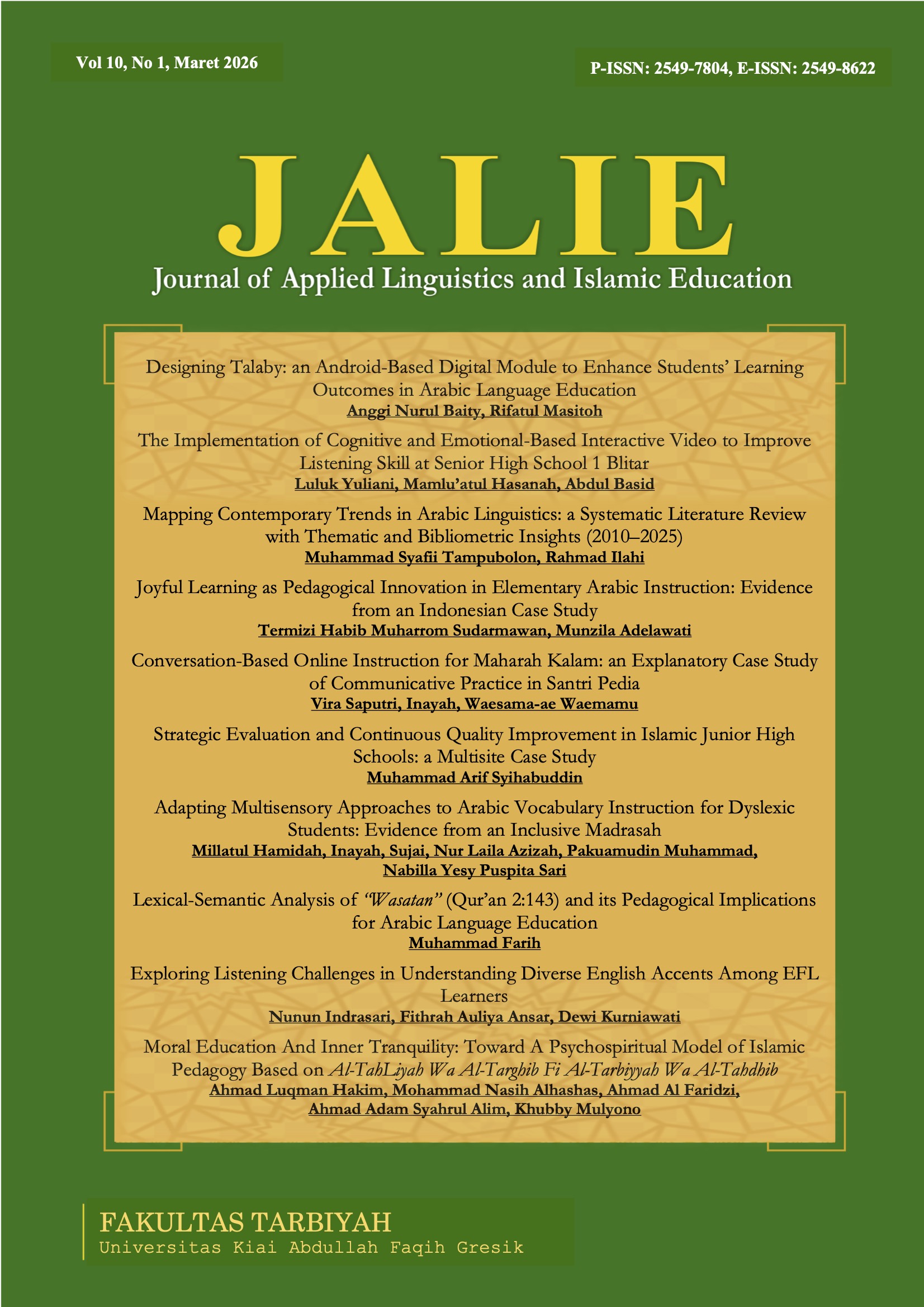
Copyright (c) 2026 JALIE: Journal of Applied Linguistics and Islamic Education

This work is licensed under a Creative Commons Attribution-NonCommercial 4.0 International License.



.jpg)
.jpg)
1.jpg)