DEVELOPING AN ETHICAL-PEDAGOGICAL FRAMEWORK FOR AI-ASSISTED MAH?RAH KIT?BAH LEARNING: A WAHDATUL ‘UL?M PERSPECTIVE

 Abstract views: 58
,
Abstract views: 58
,
 PDF downloads: 20
Abstract
The rapid advancement of Artificial Intelligence (AI) has transformed Arabic language learning, particularly Mah?rah Kit?bah (writing skills). Generative AI enables students to receive immediate assistance in translation, text composition, grammatical correction, and academic writing. However, its integration into learning also raises pedagogical and ethical concerns, including cognitive dependency on AI, diminished authenticity of students’ academic work, weakened critical thinking, and challenges to academic integrity. This study develops an ethical-pedagogical framework for AI-assisted Mah?rah Kit?bah learning from the perspective of the Wahdatul ‘Ul?m paradigm. Employing a qualitative library research design, the study adopts philosophical, pedagogical, and ethical-normative approaches. Data were collected from scholarly literature on AI in education, Arabic language pedagogy, academic integrity, and the Wahdatul ‘Ul?m paradigm, and analyzed using content analysis. The findings indicate that AI should function as a learning support tool rather than a substitute for students’ intellectual processes. The study proposes an ethical-pedagogical framework that integrates academic integrity, the authenticity of students’ academic work, critical thinking, lecturers’ pedagogical supervision, and academic adab to support the ethical implementation of AI in Mah?rah Kit?bah learning based on the Wahdatul ‘Ul?m paradigm.
Downloads
References
Airaj, Mohammed. “Ethical Artificial Intelligence for Teaching-Learning in Higher Education.” Education and Information Technologies 29, no. 13 (2024): 17145–67. https://doi.org/10.1007/s10639-024-12545-x.
Al-Attas, Syed Muhammad Naquib. The Concept Of Education In Islam : A Framework For An Islamic Philosophy Of Education. 1st ed. Kuala Lumpur: Ta’dib International, 2023.
Albantani, Azkia Muharom, Nurkhamimi Zainuddin, Nair Swathi, and Abd Rozak. “Future-Proofing Arabic Studies : A Strategic Artificial Intelligence Competency Framework for Islamic Higher Education.” BORNEO JOURNAL OF LANGUAGE AND EDUCATION 6, no. 2 (2026): 204–15. https://doi.org/https://doi.org/10.21093/benjole.v6i2.12803.
Amir, Bakhrum. “Pemanfaatan Aplikasi ChatGPT Dalam Meningkatkan Kemampuan Mahasiswa Pada Mata Kuliah Maharoh Kitabah.” LUGHOTI 7, no. 1 (2024): 37–59.
Asmawi, Nurul Fitri, and Nurfaradilla Mohamad Nasri. “The Future of Islamic Education in the Age of Artificial Intelligence: Trends and Implications.” International Journal of Academic Research in Progressive Education and Development 15, no. 1 (2026): 1468–78. https://doi.org/https://dx.doi.org/10.6007/IJARPED/v15-i1/27659.
Attruk, Muhammad Fariq Heemal, and Nik Hanan Mustapha. “Critical AI Literacy in Arabic Language Education : Rethinking Teacher Roles , Ethics , and Curriculum in the Age of Generative AI.” Global Education Journal 4, no. 2 (2026): 255–70. https://doi.org/https://doi.org/10.59525/gej.1714.
Budiyanto, Ali Said Al Matari, Adiyono, and Fahmy Ferdian Dalimarta. “Transforming Islamic and Moral Education with Generative AI: A Statistical Systematic Review.” Syamil 13, no. 3 (2025): 337–52. https://doi.org/https://doi.org/10.21093/sy.v13i3.11935.
Carr, N. The Shallows: What The Internet Is Doing To Our Brains. WW Norton, 2010.
Chan, Cecilia Ka Yuk, and Wenjie Hu. “Students ’ Voices on Generative AI : Perceptions , Benefits , and Challenges in Higher Education.” International Journal of Educational Technology in Higher Education 20, no. 43 (2023). https://doi.org/10.1186/s41239-023-00411-8.
Cotton, Debby R E, Peter A Cotton, and J Reuben Shipway. “Chatting and Cheating: Ensuring Academic Integrity in the Era of ChatGPT.” Innovations in Education and Teaching International 61, no. 2 (March 2024): 228–39. https://doi.org/10.1080/14703297.2023.2190148.
Denzin, N K. The Research Act: A Theoretical Introduction to Sociological Methods. Methodological Perspectives. Transaction Publishers, 2017.
Fazar, Ibnu. “The Use of Artificial Intelligence-Based Generative Learning Media to Improve Arabic Language Learning Strategies.” Al-Irfan: Journal of Arabic Literature and Islamic Studies 9, no. 1 (2026): 415–38. https://doi.org/https://doi.org/10.58223/al-irfan.v9i1.729.
Gerlich, Michael. “AI Tools in Society : Impacts on Cognitive Offloading and the Future of Critical Thinking.” Societies 15, no. 1 (2025): 1–28. https://doi.org/https://doi.org/10.3390/soc1501000.
Habash, Nizar. Introduction to Arabic Natural Language Processing. San Rafael, CA: Morgan & Claypool, 2010. https://doi.org/https://doi.org/10.2200/S00277ED1V01Y201008HLT010.
Holmes, Wayne, and Fengchun Miao. Guidance for Generative AI in Education and Research. Unesco Publishing, 2023.
Hyland, Ken. Second Language Writing. Cambridge Language Education. Cambridge University Press, 2003. https://doi.org/https://doi.org/10.1017/CBO9780511667251.
International Center for Academic Integrity (ICAI). “The Fundamental Values of Academic Integrity (3rd Ed.).” International Center for Academic Integrity., 2021.
Jaakkola, Elina. “Designing Conceptual Articles: Four Approaches.” AMS Review 10, no. 1 (2020): 18–26. https://doi.org/10.1007/s13162-020-00161-0.
Khairani, Dede, and Salminawati. “Tinjuan Paradigma Wahdatul Ulum Dalam Filsafat Dan Sains Islam.” Al-Afkar 8, no. 3 (2025): 1369–76. https://doi.org/10.31943/afkarjournal.v8i3.1517.Wahdatul.
Kofinas, Alexander K., Crystal Han-Huei Tsay, and David Pike. “The Impact of Generative AI on Academic Integrity of Authentic Assessments within a Higher Education Context.” British Journal of Educational Technology 56, no. 6 (2025): 2522–49. https://doi.org/https://doi.org/10.1111/bjet.13585.
Mardiah, M, and Syaifuddin Sabda. “Multi , Inter , and Transdisciplinary Islamic Education ( A Theoretical Review on Islam Perspective ) Pendidikan Islam Multi , Inter , Dan Transdisipliner ( Tinjauan Teoritis Dalam Perspektif Islam ).” Jurnal ISO 2, no. 1 (2022): 99–108. https://doi.org/https://doi.org/10.53697/iso.v2i1.665.
Maulana, Muhammad Jafar, Cecep Darmawan, and Rahmat. “Penggunaan Chatgpt Dalam Pendidikan Berdasarkan Perspektif Etika Akademik.” Bhineka Tunggal Ika: Kajian Teori Dan Praktik Pendidikan PKn 10, no. 01 (2023): 58–66.
Miao, Fengchun, and Mutlu Cukurova. AI Competency Framework for Teachers. France: UNESCO, 2024. https://doi.org/https://doi.org/10.54675/ZJTE2084.
Muh Sabilar Rosyad, Muhammad Ainul Haq. “Efektivitas Situs Berbasis Kecerdasan Buatan Dalam Mendesain Tes Keterampilan Mendengar.” JALIE: Journal of Applied Linguistics and Islamic Education Volume 06, Nomor 01, Maret 2022; p-ISSN: 2549-7804; e-ISSN: 2549-8622; 27-44 06 (2022): 27–44.
Mustofa, Amrin, Syailendra Sabdo Djati PS, Suci Rafi Sari, and Rofi Wirawan. “Use of AI Artificial Intelligence ChatGPT for Arabic Language Learning Media.” At Turots: Jurnal Pendidikan Islam 6, no. 1 (2024): 236–49. https://doi.org/https://doi.org/10.51468/jpi.v6i1.690.
Rahayu, Indah, Handrini Ardiyanti, Loso Judijanto, A Hamid, and Eyad Saleh Bani-Domi. “ETHICAL DILEMMAS AND MORAL FRAMEWORKS: NAVIGATING THE INTEGRATION OF ARTIFICIAL INTELLIGENCE IN ISLAMIC SOCIETIES.” International Journal of Teaching and Learning 1, no. 3 (2023): 171–83.
Rosyad, Muh. Sabilar, Nuha Muhammad Afthon Ulin, Hafidz Muhammad, Rozaq Muhammad Abdur, Nuruddin Ahmad, and Abdul Ghani bin Md Din. “From CEFR to AI-Assisted Learning: Contemporary Transformations in Arabic Language Teaching for Non-Native Speakers.” ATHLA: Journal of Arabic Teaching, Linguistic and Literature 7, no. 1 (2026): 37–56. https://doi.org/10.22515/athla.v7i1.14295.
Rosyad, Muh Sabilar, and Laila Farah Fitria. “Beyond Textbooks: Designing AI-Augmented Arabic Teaching Materials for Personalized Learning in Higher Education.” Kitaba 4, no. 2 (2026): 129–46. https://doi.org/10.18860/kitaba.v4i2.43410.
Rosyad, Muh Sabilar, Achmad Fudhaili, Muhammad Afthon Ulin Nuha, and Abdellah Al-Hatouk. “How Output-Based Standardisation of Writing Skills Learning Should Be Implemented for Non-Arabic Speakers.” JALIE: Journal of Applied Linguistics and Islamic Education 9, no. 1 (2025): 117–36. https://doi.org/10.33754/jalie.v9i1.1494.
Sari, Ana Kurnia, Khoirul Amin, and Mustiza Isnanimataka. “Etika Artificial Intelligence ( AI ) Dalam Pendidikan Islam : Mengatasi Tantangan Distorsi Dan Misinterpretasi.” International Conference on Tradition and Religious Studies 3, no. 1 (2024): 350–59.
Sholikha, Riadhotus, and Muh Sabilar Rosyad. “Pemikiran Filsuf Dalam Pendidikan Islam.” MIYAH: Jurnal Studi Islam 21, no. 01 (2025): 51–66. https://doi.org/10.33754/miyah.v21i01.1388.
Walisongo, UIN. “SK Rektor Nomor 204 Tahun 2016 Tentang Paradigma Unity of Sciences (Wahdatul ‘Ul?m) UIN Walisongo Semarang.” UIN Walisongo Semarang, 2016.
Yasmar, Renti, Adillah Suja, and Ahmad Fadel Syakir Hidayat. “Pemanfaatan ChatGPT Dalam Meningkatkan Keterampilan Menulis/Maharah Kitabah Berbasis6C (Critical Thinking, Creativity, Collaboration,Communication,ComputationalandCompassion).” Al-Jawhar : Journal of Arabic Language 1, no. 2 (2023): 87–104. https://doi.org/https://doi.org/10.69493/ajoal.v1i2.28.
Yenuri, Ali Ahmad. “Etika Akhlaq Dalam Kurikulum Pendidikan Islam Di Indonesia: Sebuah Tinjauan Sistematis Literatur.” JALIE 8, no. 2 (2025): 363–78. https://doi.org/https://doi.org/10.33754/jalie.v8i02.1439.
Zebua, Azwar Muharram, Rahmat Rifai Lubis, Anni Ropiah Batubara, Ariskan Kubawa Saragih, and Suhalimatussa’diah. “Pembentukan Karakter Mahasiswa UIN Sumatera Utara Melalui Konsep Wahdatul Ulum.” AL MURABBI 8, no. 2 (2022): 39–48. https://doi.org/https://doi.org/10.53627/jam.v8i2.4610.
Zhang, Shunan, Xiangying Zhao, Tong Zhou, and Jang Hyun Kim. “Do You Have AI Dependency ? The Roles of Academic Self-Efficacy , Academic Stress , and Performance Expectations on Problematic AI Usage Behavior.” International Journal of Educational Technology in Higher Education 21, no. 34 (2024). https://doi.org/https://doi.org/10.1186/s41239-024-00467-0.
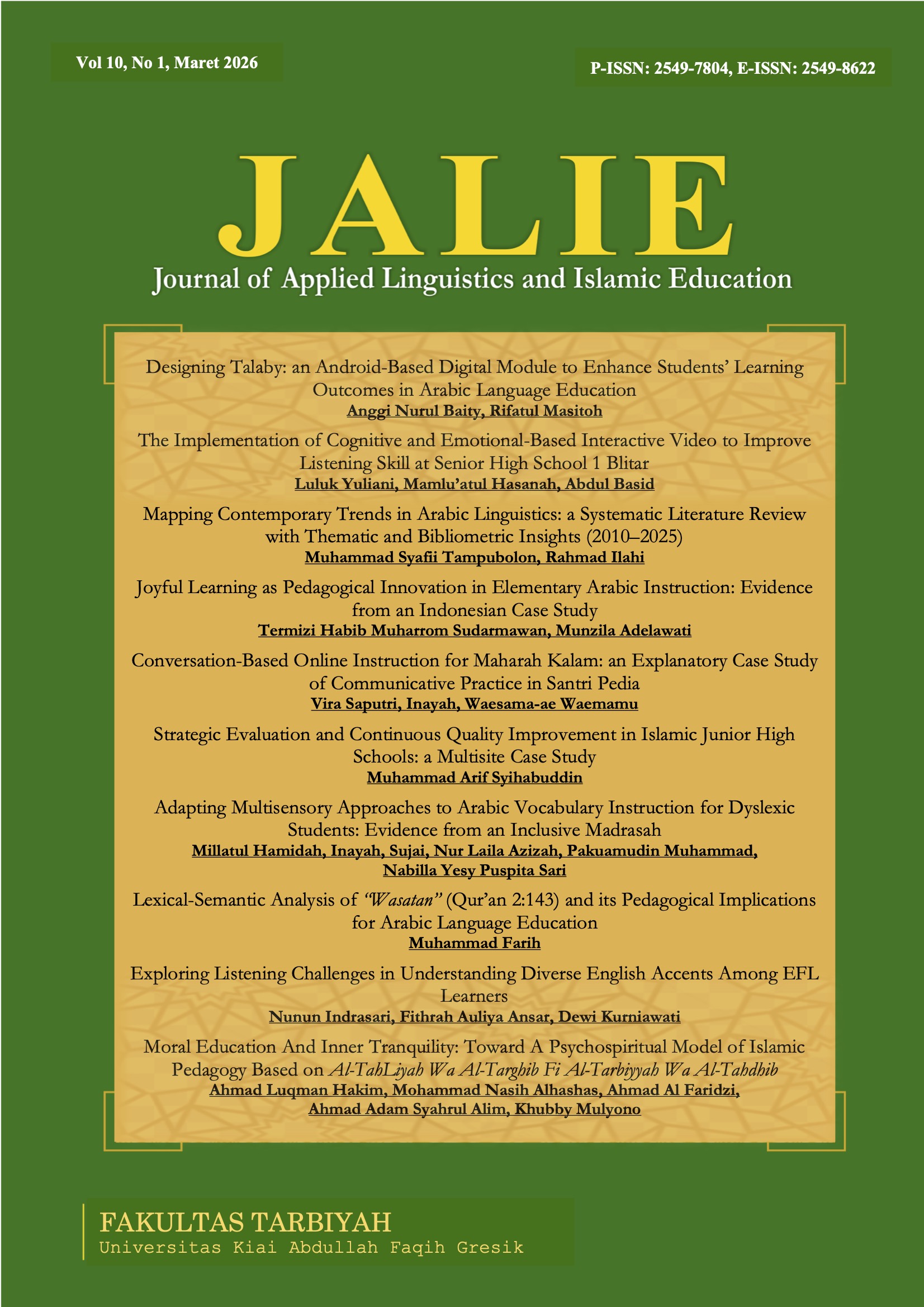
Copyright (c) 2026 JALIE: Journal of Applied Linguistics and Islamic Education

This work is licensed under a Creative Commons Attribution-NonCommercial 4.0 International License.



.jpg)
.jpg)
1.jpg)